I worked on piano chord inversions. I noticed that if neighbouring chords share a note it’s better to keep that note for both chords and use an inversion to keep the chords close together positionally on the keyboard. A good example of this is the I to V: C E G to G B D, you keep the G note and play a V6; this means that the chords will remain close together and you only need to change 2 notes. I spent some time going through some simple chord progressions and seeing if they had similar notes and how best to keep them.
18/09/2019 Seventh Day
I was ill 😦 and did not get to experience the awesome class.
KAME week 6
I chose the song I will teach, it’s ‘Bell’s Horses’. I haven’t heard of this song but it’s simple lyrically and melodically which will be perfect for teaching the imagined kindergarten class. Our lecturer Bronwyn mentioned methods and reasons to embed aspects of student’s backgrounds and cultures into lessons and I thought since we are in Australia it wouldn’t be far-fetched to assume that there would be some students with New Zealand heritage; to apply this idea I will use a kiwi fluffy toy and change the lyrics “Bell’s Horses” to “Hey Kiwi”. This week I worked on sus2 and sus4 chords and although the theory is not difficult for me I struggle with the transitioning of chords; even still i watched this video to make sure that there’s nothing else I need to know when playing sus chords on keyboard/piano.
Game of Tones
All about that ‘Gamification’ in music education. We have come a long way since the days when I used to spend countless hours playing Sega Mega Drive and thinking the graphics were so real that my house was in fact being invaded by space aliens. There was a lot of discussion on the pros and cons of using games in music education and the research behind it. I personally am for it but not in the sense that students get rewards for progressing in games as I want them to have intrinsic motivation, I’d rather use Gamification to make the learning process more fun and memorable. There were some websites that were mentioned like http://rhythmdr.com, https://isleoftune.com, https://teachedm.com and https://learningmusic.ableton.com. I found the ‘teach EDM’ course interesting as a class unit if a school was willing to pay the license fee, I think students would be totally engaged and it would be accessible to those with no music experience. I was super intrigued by https://www.coursera.org/learn/music-education as it allows you to do a heap of short courses on varying topics from leading universities AT YOUR OWN PACE!!! ALL YEAR ROUND!!! AND ITS FREE!!! ……….unless you want a certificate at the end… but still I really think that’s cool and want to do a few short courses on the music business side of things. Later we discussed the effect of technology on the human brain, analysed some research and the consensus is not good … on that note I’d better do some mindfulness before this screen traps me in its matrix.

KAME week 5
Still have not decided which song I’m going to teach ARGGH… I’ll work it out soon though. This week I worked on the ‘Rhythm Syllable Guide’ worksheet as I want to be prepared for any situation that may arise when choosing a song and teaching it. The use of this system would be less of an issue if I wasn’t more familiar with French Time names and Takadimi but it shouldn’t be a problem and K-6 won’t be dealing with complex rhythms. This week on keyboard I worked on turning every chord that I have worked on thus far into a 7th chord. The biggest problem I seemed to be having was the finger stretch of the right hand and which finger to use but as I experimented a bit I found the positions that worked for me.
Fantasia
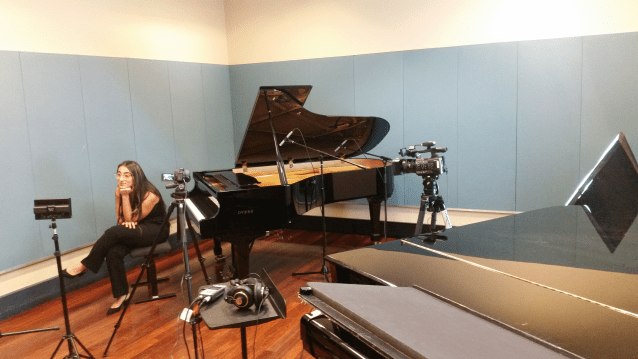
Set up a studio recording for a piano performance and an interview after; this included 3 cameras, 2 lights, 2 mics, piano and performer. We had trouble finding the right audio level as there were extremely contrasting dynamics on the piano thanks to the ‘col pugno’ which I now know is the Italian music term for HULK SMASH!!. There was a fixed camera for the face shot, one for the hands/piano and one for action movement which Humbo (my teacher) was filming as he maneuvered through the set like a level 3 ninja mage with +3 to dexterity. The cameras/lights had to be rearranged to film the interview which was done without microphones but was not too difficult to manage and the only thing that followed was the dreaded pack up. I was slightly overwhelmed by the process as I am used to filming with my outdated phone with no great concern for quality, angles and action shots let alone positioning a microphone effectively. I can definitely see the benefits of knowing how to film in this new age of YouTube, podcasts and Instagram being a huge part of many people’s lives, and it could be a fun project to assign a class.
KAME week 4
This week I worked on the 3rd Curwen hand-sign exercises from the Solfa Musicianship Drills worksheet; it’s tricky but I improved a lot in a small amount of time. I haven’t quite thought about which song I’m going to do for my assignment though i am thinking of doing a song with only Do Mi So La so it is within my singing ability. I reviewed my first 3 weeks of keyboard practice and did not add anything new to my practice schedule but rather worked on moving between chords I’ve already worked on smoothly. I notice that I struggle with the chords that use black keys as I am trying to match the best finger to the sharp as I lay all fingers down simultaneously.
You have the copyright to remain silent!
This lesson was divided into 2 parts where the first half was all about the lovely and complicated world of video editing. We used Screenflow for this task and learned about things like trimming, syncing audio, opacity, basic animation and non-destructive editing. I got the hang of it towards the end so with the thought of having some editing software for me at home I did a bit of research, and it looks like …. it doesn’t work on Windows PC LOL! But I found some alternatives like Adobe Premiere Elements 2020 for around $150 and Filmora for Windows for $60. The next half of the class was about copyright in music and how Australia’s copyright is the worst going around. I had already known about these groups but refreshed my knowledge of APRA, AMCOS, ARIA and PPCA. There is no ‘fair use’ in Australia and after hearing the guest speakers I was concerned that I was going to be sued for royalties for singing songs in the shower; it really gave me the vibe that there’s very little chance of making money by becoming a proficient musician. I found out that APRA and AMCOS can collect royalties for you but you basically have to sign over your music rights to them so they are actually in control of the permission to use your music material ….. yeaaaaaah NO THANKS!!
I was going to embed a video here of me playing Jethro Tull’s ‘Aqualaung’ on Jazz flute, but due to the many possible copyright infringements instead here is a royalty and copyright-free image from the awesome site Pixabay

KAME week 3
This week I worked on a blues-type progression using A D E and E A B. I wanted to get used to some new chords and some slightly different voicings; I didn’t work on soloing, only bass notes in left hand and harmony in the right hand. The shuffle feel wasn’t too much of an issue it is more just the transitioning between chords that slows me down, especially because of the use of sharps (black keys). I’ve also been working on my Curwen hand-signs and singing, I’ve got all the Kodaly sheets from Canvas printed in a folder and have just been working on my singing pattern Do, Do Re Do, Do Re Mi Re Do etc and then descending from the octave up. My goal in the next few weeks is to move away from using root position voicings all the time. I watched the video below and it was useful, though I wanted to move away from the key of C and I tried to make my own little blues bass line to go with it; I didn’t get around to using 7th chords just yet but I will next week.
Do you even notate?
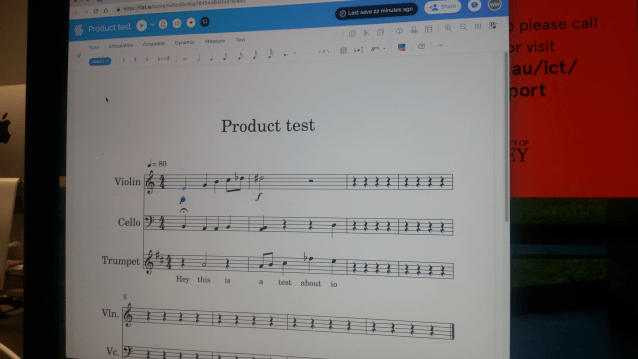
Today we discussed notation programs in great detail and I found out that my teacher Mr Humberstone was a Level 4 Technology Wizard who had been a Sibelius programmer for many years. We discussed programs like Noteflight, Flat io, Doric, Sibelius, Finale and Musescore with focus on their unique features, subtle nuances and ideal uses for them. I did a product test of Flat io which I thought was well designed for a school setting as it had all the necessary features a school student would need. I like it better than Noteflight as it had a ‘fixed’ ribbon system at the top whereas Noteflight could change based on what had been pressed; this was a cause of great annoyance when teaching a class on prac (the memory still haunts me). However, Noteflight did have a cool feature where you could upload a score to its database and if it had not been done before, it would become part of its catalogue ANDDDD when people downloaded it you would get paid royalties. A cool feature of Flat io was an export video option that could be played along with an online novel and also a mini screenshot option that was way quicker and simpler to use. As a notation program to be used in a classroom setting I give Flat io 4 rubber chickens out of 5. Flat io product test below.
 JohnMuTech